
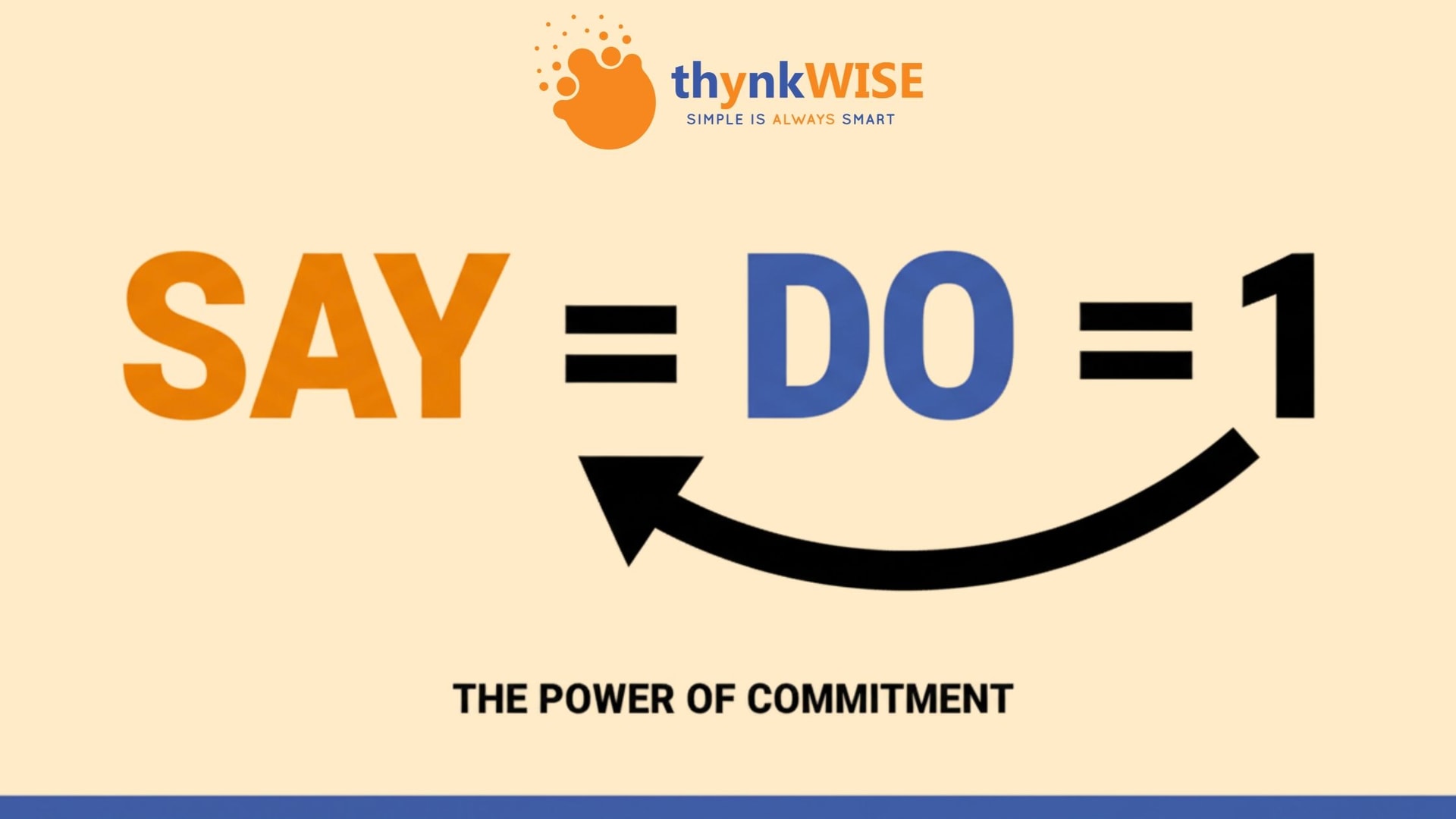
Is Your Say-Do Ratio = 1?
In sales, you can have the sharpest pitch, the best product, and the warmest rapport, and still lose the deal. Not because of price. Not because of competition. But because somewhere along the way, the prospect stopped believing your word.
That belief has a name. It is your say-do ratio: how often your actions actually match what you said you would do. Say you will send the proposal by Friday, and send it by Friday, that is a ratio of 1. Say it, and send it Monday, and the number drops. So does the trust.
Why This Is the Most Powerful Trust Signal in Sales
Prospects cannot see your intentions. They cannot verify your promises in advance. So they do the only thing they can: they watch what you do against what you said. Every kept promise is evidence that you are reliable. Every broken one is evidence that you are not.
This matters enormously in high-ticket sales, where the decision to buy is really a decision to trust. Nobody hands over a significant budget to someone whose word they quietly doubt. The bigger the deal, the more the say-do ratio decides the outcome.
And here is the part most salespeople miss: the trust-building (or trust-breaking) happens long before the close. It happens in the small moments. Did you call back when you said you would? Did the follow-up email arrive when promised? Did you show up to the meeting on time, prepared, as agreed? Each of these is a micro-test, and the prospect is grading every one.
Nothing Destroys Trust Faster Than Say-Do Gaps
A single broken promise rarely kills a deal outright. But it plants a doubt. And doubt compounds.
Once a prospect catches you saying one thing and doing another, even on something small, they recalibrate. They start mentally discounting everything you say. "He said the quote covers everything, but he also said he'd call Tuesday and didn't, so what else is slipping?" That quiet recalibration is where deals die, not in dramatic rejection, but in slow erosion of confidence.
The reps who consistently close are rarely the most charismatic. They are the most reliable. Their word is bankable. When they say something will happen, the prospect can build on it without hedging. That reliability is a closing advantage that no amount of charm can replace.
How to Raise Your Say-Do Ratio
The goal is a ratio of 1: you do everything you said you would. Reaching it is less about effort and more about discipline at the point of promising.
Most broken commitments are not laziness. They are overpromising in the moment. It feels good to say yes, to impress, to seem accommodating. So we commit to timelines we have not actually checked. The fix is to slow down before you commit. Promise only what you know you can deliver, then deliver it. A smaller promise kept beats a bigger promise missed every time.
Next, track what you commit to. You cannot close a gap you are not watching. Keep a running list of what you have promised each prospect and when. Review it daily.
Finally, close the loop visibly. When you do what you said, make sure they see it. A simple "as promised, here is the proposal" turns a kept commitment into a trust deposit. Over a sales cycle, those deposits add up to a relationship the prospect feels safe buying into.
How thynkWISE Helps You Own It
At thynkWISE, we treat the say-do ratio as a core sales discipline, not a soft skill. Through our High Ticket Closing approach, we help sales teams build the habits of reliability that make trust automatic: making cleaner commitments, tracking follow-through, and turning consistency into a closing edge.
Because in the end, the most persuasive thing you can do in a sale is also the simplest. Say what you will do. Then do it.
So ask yourself before your next call: is your say-do ratio = 1?